20 Jupiter Facts for 2026: Its Red Spot May Be an Impostor and Its Moon Count Just Doubled
Jupiter is so heavy that it doesn’t orbit the Sun — the two orbit a point in empty space just above the Sun’s surface. Its most famous storm may be an impostor, its moon count has nearly doubled since this post was first written, and two spacecraft are on their way to find out whether its moon Europa is alive. Here are 20 facts about the king of planets, re-checked for 2026.
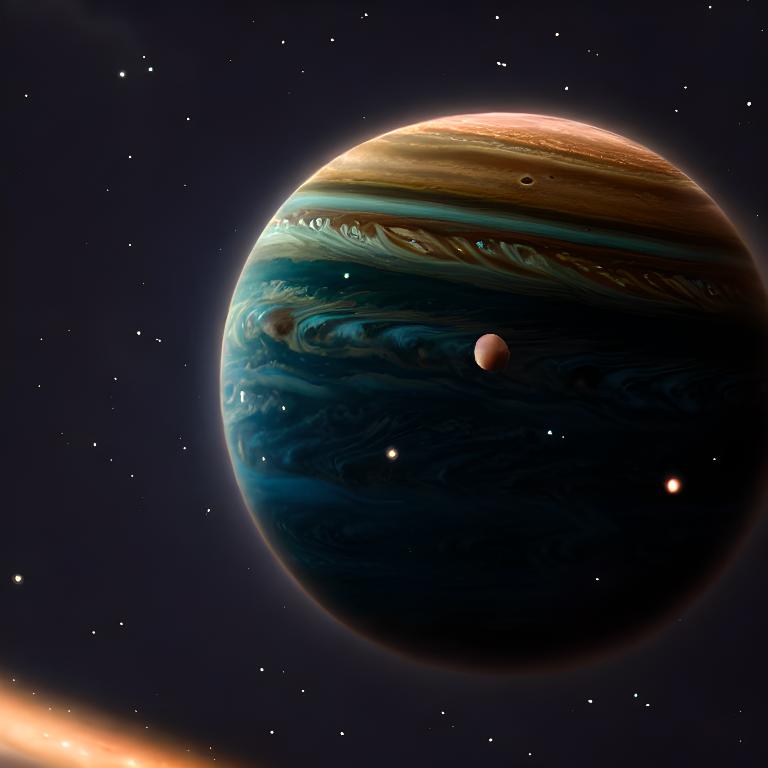
The five that put Jupiter in perspective
20 unique facts about Jupiter
The planet
- Jupiter is 2.5 times heavier than all the other planets combined — 318 Earth masses of mostly hydrogen and helium, the same recipe as the Sun.
- It isn’t a “failed star”, but it is close. Jupiter would need about 80 times more mass to ignite fusion. Still, it radiates more heat than it receives from the Sun, left over from its formation.
- The Sun orbits Jupiter — a little. Their shared centre of mass lies about 48,000 km outside the Sun’s surface, so the Sun visibly wobbles around it. It is the only planet massive enough to do this.
- Its day is under 10 hours. The rotation is so fast that Jupiter bulges: it is 9,000 km wider at the equator than pole to pole.
- Jupiter has rings. Three faint ones of dust knocked off its small inner moons, discovered by Voyager 1 in 1979 — invisible from Earth.
- It rains helium inside Jupiter. Deep down, helium separates from hydrogen and falls as droplets toward the core — a process confirmed by Juno’s gravity measurements.
- The core isn’t solid. Juno Instead of a compact rock, Juno found a “fuzzy” core of heavy elements spread across nearly half the planet’s radius — possibly the scar of a giant collision early in its history.
- Its magnetic field is 20,000 times stronger than Earth’s in total strength, and its radiation belts would deliver a lethal dose to an unshielded astronaut in a day.
The weather
- The Great Red Spot is shrinking. In the 1800s it was about three Earths wide; today it is about 1.3 Earths across and still contracting.
- It may not be the storm Cassini saw in 1665. 2024 A study of historical drawings found that spot vanished in 1713; the current Red Spot was first recorded in 1831 — making it under 200 years old.
- The Red Spot is 500 km deep, Juno measured in 2021 — 50 times deeper than Earth’s oceans, though shallow compared with the planet.
- Jupiter’s poles are crowded with cyclones. Juno found eight storms arranged in an octagon around the north pole and five around the south, each the size of a continent, stable for years.
- Wind speeds reach 600 km/h in the jet streams between the cloud bands — and the bands themselves spin in opposite directions.
- Jupiter has lightning — and it is upside-down compared with ours. Juno detected “shallow lightning” in ammonia-water clouds high in the atmosphere, something that cannot happen on Earth.
The moons and the missions
- Ganymede is bigger than Mercury and is the only moon in the Solar System with its own magnetic field — and it, too, hides a salty ocean.
- Io is the most volcanic world known, with over 400 active volcanoes, kneaded by Jupiter’s gravity; its eruptions reach 400 km high.
- Jupiter protects Earth. Its gravity flings many comets and asteroids out of the inner Solar System — in 1994 it swallowed comet Shoemaker–Levy 9 in 21 pieces, leaving scars larger than Earth.
- Juno has orbited Jupiter since 2016, years beyond its planned lifetime, on a looping orbit that dodges the worst of the radiation belts.
- Two more spacecraft are on the way. 2024 ESA’s JUICE (launched 2023, arriving 2031) will orbit Ganymede; NASA’s Europa Clipper (launched 14 October 2024, arriving 2030) will fly through Europa’s water plumes looking for the ingredients of life.
- You can see the Galilean moons with binoculars. Io, Europa, Ganymede and Callisto appear as four dots in a line beside Jupiter — exactly what Galileo saw in 1610, the discovery that proved not everything orbits the Earth.
Three Jupiter “facts” that are out of date
The count passed 95 in 2023 — and Saturn now leads with 274 after a 2025 batch of discoveries.
Once true. It is now about 1.3 Earths wide and shrinking.
At the cloud tops it is roughly 14–20 times stronger, but in total it is about 20,000 times more powerful — the largest structure in the Solar System after the Sun’s own field.
More from the cosmos
20+ Amazing Space Facts That Still Hold Up
Chandrayaan-3: What India’s Moon Landing Actually Found
20 Solar Storm Facts
The Dark Forest Theory: Why We Haven’t Found Aliens
Sources: NASA – Jupiter facts · NASA – Jupiter’s moons · Science News – Great Red Spot may be under 200 years old (2024) · NASA – Juno mission · NASA – Europa Clipper · ESA – JUICE
Last fact-checked: October 2026.
Still curious?
One click, one random mind-blowing fact.